
Water disinfectants for potable water are imperative for enterprises or industries and the healthcare industry to avoid the dissemination of waterborne pathogens, satisfy regulatory compliance, safeguard sensitive equipment from damage, and maintain product consistency.
Untreated water can accumulate biofilms, algae, and microbes that accelerate corrosion, scaling, and fouling in pipes, boilers, cooling towers, and RO systems. Multiple studies from the Central Pollution Control Board (CPCB) point out that untreated groundwater in industrial hubs carries microbial risks, leading to downtime, health claims, and fines. Hence, maintaining high-quality water is fundamental, especially for healthcare facilities that have specific, stringent specifications to protect immunocompromised patients.
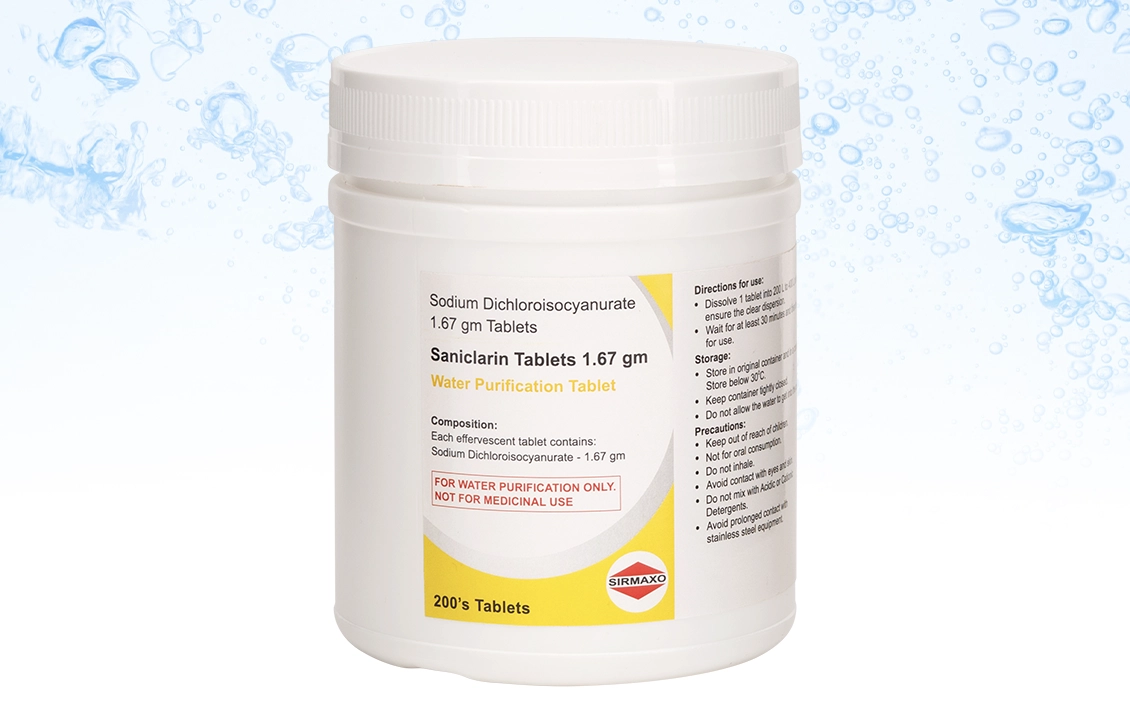
That’s where water disinfectants and water disinfection systems come into the picture and are the integral components of modern potable water treatment frameworks. Facilities must integrate advanced filtration (such as ceramic/GAC) with water disinfectants (like Saniclarin Tablets Supplied by SirMaxo) to ensure disinfection of potable water, preventing outbreaks and supporting environmental, social, and governance (ESG) goals.
What are Water Disinfectants?
Water disinfectants are chemical or physical agents, such as chlorine, ozone, or UV light, used to kill or inactivate pathogenic microorganisms (bacteria, viruses, and parasites) in water.
Their main purpose is to make water safe for drinking, processing, or reuse by preventing waterborne diseases and protecting public health. Chlorine (Cl₂/hypochlorite) is one of the most widely used methods, usually considered the standard for disinfection because it provides a lasting residual that safeguards against recontamination.
Ensuring access to safe drinking water is more important than ever, when more than one billion people worldwide die each year due to waterborne pathogenic microorganisms. That’s why the application of water disinfectants in hospitals, veterinary clinics, schools, transportation, hospitality, and other facilities is important for community health.
The Mechanism of Action
The mechanism of action may vary based on the type of water disinfectants for portable water or systems. They generally work by breaking down crucial cellular structures, halting metabolism, or damaging the genetic material of pathogenic microorganisms, making them unable to reproduce.
For Example, Sirmaxo’s formulations, Saniclarin Tablets with Sodium Dichloroisocyanurate – 1.67 gm, deliver stable hypochlorous acid (HOCl). It is a chlorine‑based disinfectant, effervescent tablet for water purification with broad-spectrum efficacy, maintaining residuals as per BIS standards. This minimizes biofilm formation in water systems.
Why Do Facilities Need Water Disinfectants
Hospitals are high-risk environments for the spread of bacteria, viruses, and pathogens via water. Disinfection safeguards vulnerable patients, particularly in units like intensive care, burns, and oncology.
Hemodialysis demands ultra-pure, sterile water to avoid infections during treatment. Similarly, lab tests need high-quality water for accuracy. In manufacturing and power plants, clean water lowers occupational‑health risks for workers utilizing water‑based processes or showers.
In food and beverage processing, these disinfectants make sure that wash water, ice, and final product water do not introduce contaminants that spoil taste, shelf life, or safety.
In pharma and semiconductor manufacturing, high‑purity water must be free of microbial contamination to avoid batch failures, potential recalls, and regulatory action.
Different Types of Water Disinfectants
Here are some common lists that help in sanitizing water.
A. Chemical Disinfectants
- Chlorine (Hypochlorite, Gas): It forms hypochlorous acid (HOCl) and hypochlorite ions (OCl⁻), strong oxidizers. These penetrate microbial cell walls and kill them.
- Chloramines (Monochloramine): It is a combination of chlorine and ammonia, providing a longer-lasting residual disinfection (continues to kill germs on a surface long after initial application).
- Ozone (O3): It is a powerful oxidizing agent that destroys microorganisms and leaves no harmful residual. Additionally, it improves water clarity, taste, and odor.
- Chlorine Dioxide (ClO2): It is a strong oxidant that breaches cell walls and reacts with microorganisms’ amino acids, proteins, and DNA to kill them. It is effective over a wide pH range, particularly for viruses and protozoa.
- Calcium Hypochlorite Ca(ClO)₂: It dissolves in water and produces hypochlorous acid, damaging microbial membranes and metabolic processes.
- Sodium Hypochlorite (Bleach): It releases hypochlorous acid upon dilution. Then it oxidizes microorganisms’ cell proteins and genetic material to kill them and stop their growth.
- Peracetic Acid (CH₃CO₃H): Peracetic acid is a strong oxidizing disinfectant that can inactivate a broad range of microorganisms and is used in certain water and industrial disinfection applications.
B. Physical Disinfectants
- Ultraviolet (UV) Light: The UV light emits short-wavelength radiation that binds pathogen DNA/RNA and stops their replication. It’s chemical-free and effective against many pathogens. However, water must be pre-filtered and have no residue, as particulate matter can block UV light.
- Boiling or Heat: High temperatures kill microbes. Boiled water can be used for small quantities when an appropriate heat treatment method is available.
C. Other Disinfectant Methods
- Filtration: Physically eliminates pathogens using barriers such as sand or membranes. It is often a pretreatment step for UV.
- Solar Disinfection (SODIS): This method uses sunlight’s UV and heat in clear plastic bottles to sterilize small amounts of water.
Disinfection of Water Systems: Best Practices
Chlorine-based methods are the best due to affordability and residuals for potable water systems.
Facilities should implement multi-barrier approaches: pre-filtration → disinfection → residuals monitoring. Water systems should be regularly cleaned and disinfected according to the facility’s maintenance and infection-control requirements.
In healthcare settings, this aligns with NABH standards, and in hospitality, it prevents Legionella in cooling towers.
What Are the Steps for Drinking Water Disinfection With Sodium Dichloroisocyanurate (Saniclarin Tablets)
Here are the steps:
- Remove visible dirt, turbidity, and large particles from the water.
- Add 1 tablet per 20 liters (follow the manufacturer’s instructions) into the water container.
Ensure the tablet is well dissolved and is evenly distributed. - Allow the required contact time for the disinfectant to act and let the water stand so that free chlorine can inactivate pathogens.
Store the treated water in a clean, covered container to avoid recontamination.
Best Quality Water Disinfectants Supplier in India | Sirmaxo
Sirmaxo has revolutionized India’s infection prevention landscape, as it is known as India’s largest disinfectant manufacturer.
We manufacture internationally certified products ranging from hand and skin antiseptics to surface, instrument, and water disinfectants (for drinking water sanitization). We have WHO–GMP certified facilities equipped with cutting-edge manufacturing capabilities.
Searching for the best quality water disinfectants to make your drinking water safe?
You can contact Sirmaxo at info@sirmaxochem.in.
Phone number:
- +91 22 42500800
- +91 22 42500852
Our Address: 5th Floor, Satyanarayan Prasad Commercial Center, Dayaldas Lane, Off. Nehru Road, Vile Parle (E), Mumbai 400057, India.
FAQs
Q1: What are water disinfection systems?
A: The system involves using physical or chemical methods to kill or inactivate harmful microorganisms (bacteria, viruses, and parasites) in water.
Q2: How to disinfect a home water system?
A: Use a diluted, unscented bleach solution with the best quality chlorine from manufacturers like Sirmaxo to kill bacteria. You need to shut off water, add bleach to the system, let it sit for hours, and then flush thoroughly until the chlorine smell is gone. This process is known as shock chlorination.
Q3: Which chemical is used to disinfect water?
A: Chlorine, often added as chlorine gas or sodium hypochlorite (bleach), is used as the primary chemical used to disinfect water. You can buy the best quality by calling Sirmaxo at +91 22 42500800 or +91 22 42500852.


